"Supernatural Lessons from a Natural Disaster"
- Get link
- X
- Other Apps
(from a message aired in August, 2005 on Grace to You)
We live in a society unlike any in the past, a world of electronic media, a world of mass communication, a world of overexposure to relentless visual images and enhancements. We see everything and we see it constantly. In fact, we’re not isolated from anything that happens anywhere in the world. Every catastrophe, every calamity, every cataclysm, every disaster, every tragedy everywhere eventually comes to us through the media and we vicariously experience all the pain and sorrow and suffering and death, whether it’s earthquakes in Mexico, or Japan, or Indonesia, or whether it’s famine in Africa or volcanic eruptions on various islands of the sea, or whether it’s horrific hurricanes in Asia or in Florida, whether it’s plagues in India, avalanches in Europe, wars in Iraq, whether it’s genocide, whether it’s suicidal terrorists in Israel or New York City or Washington D.C. or in a Russian school, whether it’s a plane crash, a train disaster, the sinking of ferry boat in a choppy sea in the English Channel, whatever it is, we are not isolated from these disasters, natural disasters, massacres, terrible crimes, calamitous events, despotic rulers who slaughter their people, images of war, gruesome killings with body parts lying all around, the killing of unborn children by abortion, gang murders of innocent children walking along the street or playing in their yard is a way the gang member gains credibility in his organization, whatever it is, we get it all. We cannot escape the information about catastrophic car wrecks that kill people. We see them replay it again and again on the nightly news, or house fires that burn up entire families.
Read the rest of the sermon here.
We live in a society unlike any in the past, a world of electronic media, a world of mass communication, a world of overexposure to relentless visual images and enhancements. We see everything and we see it constantly. In fact, we’re not isolated from anything that happens anywhere in the world. Every catastrophe, every calamity, every cataclysm, every disaster, every tragedy everywhere eventually comes to us through the media and we vicariously experience all the pain and sorrow and suffering and death, whether it’s earthquakes in Mexico, or Japan, or Indonesia, or whether it’s famine in Africa or volcanic eruptions on various islands of the sea, or whether it’s horrific hurricanes in Asia or in Florida, whether it’s plagues in India, avalanches in Europe, wars in Iraq, whether it’s genocide, whether it’s suicidal terrorists in Israel or New York City or Washington D.C. or in a Russian school, whether it’s a plane crash, a train disaster, the sinking of ferry boat in a choppy sea in the English Channel, whatever it is, we are not isolated from these disasters, natural disasters, massacres, terrible crimes, calamitous events, despotic rulers who slaughter their people, images of war, gruesome killings with body parts lying all around, the killing of unborn children by abortion, gang murders of innocent children walking along the street or playing in their yard is a way the gang member gains credibility in his organization, whatever it is, we get it all. We cannot escape the information about catastrophic car wrecks that kill people. We see them replay it again and again on the nightly news, or house fires that burn up entire families.
Read the rest of the sermon here.
Popular posts from this blog
"On Keeping A Notebook" by Joan Didion
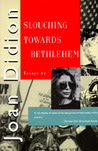
I'm nearly finished reading Joan Didion's collection of essays, Slouching Towards Bethlehem. The book was discovered through another book I was reading, Jon Krakauer's Eiger Dreams . If Jon felt this book was good enough to pack along on a mountain climbing expedition, then I'm interested. Took me three tries, but I finally found my copy on Amazon. One of the best book buys I've made. Joan selected the title of this book from William Butler Yeats' classic poem, Second Coming . The book title is shared with one of her larger essays, a record of encounters with people in the 1960's drug culture. Didion's book is divided into three distinct parts: "Life Styles In The Golden Land," a collection of articles capturing the California experience of the 1960's; "Personals," a few of essays of the first-hand nature; and "Seven Places Of The Mind", some thoughts about those parts of California that are now long gone. One essay...
I’ll Be Gnome For Christmas
“And so, about this tomb of mine . . . “
“VANITY, saith the preacher, vanity! Draw round my bed: is Anselm keeping back? Nephews—sons mine … ah God, I know not! Well— She, men would have to be your mother once, Old Gandolf envied me, so fair she was! What’s done is done, and she is dead beside, Dead long ago, and I am Bishop since, And as she died so must we die ourselves, And thence ye may perceive the world’s a dream. Life, how and what is it? As here I lie In this state-chamber, dying by degrees, Hours and long hours in the dead night, I ask “Do I live, am I dead?” Peace, peace seems all. Saint Praxed’s ever was the church for peace; And so, about this tomb of mine. I fought With tooth and nail to save my niche, ye know: —Old Gandolf cozened me, despite my care; Shrewd was that snatch from out the corner South He graced his carrion with, God curse the same! Yet still my niche is not so cramped...