HEAD(hed), (n.) 1. the top part of the human body or the front part of an animal where the eyes, nose, east and mouth are. "Your brain is in your head." DIBS(dibz), (n.) 2. a thick, sweet syrup made in countries of the East, especially the Middle East, from grape juice or dates. [Arabic "debs"]--World Book Dictionary, 1976.
Two Ways to read Homer's Odyssey (focus: the life lesson of the second option)
Get link
Facebook
X
Pinterest
Email
Other Apps
-
"One way to read The Odyssey is that it’s a story of human perseverance. Odysseus is cunning and determined, he’s willing to do everything and anything to get back to Ithaca...and eventually, because of that, he finally does. That’s certainly the interpretation of Tennyson in his poem 'Ulysses':
'We are not now that strength which in old days
Moved earth and heaven, that which we are, we are;
One equal temper of heroic hearts,
Made weak by time and fate, but strong in will
To strive, to seek, to find, and not to yield.'
But there is also a way to read The Odyssey as illustrating the exact opposite lesson. Because basically every delay and impediment on Odysseus’s long journey home is completely his fault. He says he wants to get back to Ithaca, and then proceeds to constantly undermine himself. It’s only towards the end when he finally stops and actually listens to the gods (most of whom favor him) that he quickly makes any real progress.
In fact, they finally come out and tell him this when Odysseus tries to argue with their instructions for surviving Scylla and Charybdis (he wants to stand and fight, they tell him to dart through). 'Goddess, please, tell me the truth, is there no other way?' Odysseus pleads. The goddess answers, 'No, you fool! Your mind is still obsessed with deeds of war. But now you must surrender to the gods.'
Marcus Aurelius talked about practicing the 'art of acquiescence.' Seneca and Epictetus spoke often about surrendering to fate—understanding that we are not in control, accepting that there is a larger plan for us spelled out in the logos. It seems like resignation, and it’s a very scary thing for us to try. So most people don’t. We refuse to yield, like Odysseus, and we never end up getting where we want to go.
The concept of Amor Fati is quite paradoxical. It’s acceptance fused with determination. It’s the ability to go along and make the best of something—even if every ounce of your being would rather stand and fight. It seems crazy, but it works. Because there is more at work behind the scenes than we know. There is a bigger picture we cannot see. And even if there wasn’t, the universe is much stronger than we are[emphasis mine].
That’s why it’s better to flow with it than impotently resist it."
“VANITY, saith the preacher, vanity! Draw round my bed: is Anselm keeping back? Nephews—sons mine … ah God, I know not! Well— She, men would have to be your mother once, Old Gandolf envied me, so fair she was! What’s done is done, and she is dead beside, Dead long ago, and I am Bishop since, And as she died so must we die ourselves, And thence ye may perceive the world’s a dream. Life, how and what is it? As here I lie In this state-chamber, dying by degrees, Hours and long hours in the dead night, I ask “Do I live, am I dead?” Peace, peace seems all. Saint Praxed’s ever was the church for peace; And so, about this tomb of mine. I fought With tooth and nail to save my niche, ye know: —Old Gandolf cozened me, despite my care; Shrewd was that snatch from out the corner South He graced his carrion with, God curse the same! Yet still my niche is not so cramped...
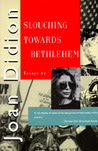
I'm nearly finished reading Joan Didion's collection of essays, Slouching Towards Bethlehem. The book was discovered through another book I was reading, Jon Krakauer's Eiger Dreams . If Jon felt this book was good enough to pack along on a mountain climbing expedition, then I'm interested. Took me three tries, but I finally found my copy on Amazon. One of the best book buys I've made. Joan selected the title of this book from William Butler Yeats' classic poem, Second Coming . The book title is shared with one of her larger essays, a record of encounters with people in the 1960's drug culture. Didion's book is divided into three distinct parts: "Life Styles In The Golden Land," a collection of articles capturing the California experience of the 1960's; "Personals," a few of essays of the first-hand nature; and "Seven Places Of The Mind", some thoughts about those parts of California that are now long gone. One essay...