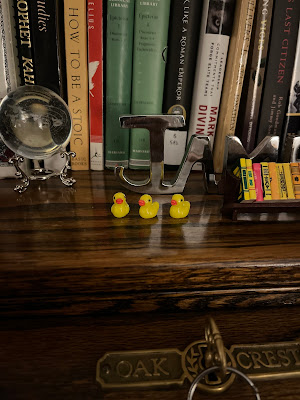
Lonely Cottage

Image
  “Among the few features of agricultural England which retain an appearance but little modified by the lapse of centuries, may be reckoned the high, grassy and furzy downs, coombs, or ewe-leases, as they are indifferently called, that fill a large area of certain counties in the south and south-west. If any mark of human occupation is met with hereon, it usually takes the form of the solitary cottage of some shepherd. Fifty years ago such a lonely cottage stood on such a down, and may possibly be standing there now. In spite of its loneliness, however, the spot, by actual measurement, was not more than five miles from a county-town. Yet that affected it little. Five miles of irregular upland, during the long inimical seasons, with their sleets, snows, rains, and mists, afford withdrawing space enough to isolate a Timon or a Nebuchadnezzar; much less, in fair weather, to please that less repellent tribe, the poets, philosophers, artists, and others who “conceive and meditate of ple...

The Beast

 So cute. Give us a hug.

“What an awful animal!” he exclaimed. I stared in my turn and couldn’t keep back a movement of revulsion. Before my eyes there quivered a horrible monster worthy of a place among the most farfetched teratological legends. It was a squid of colossal dimensions, fully eight meters long. It was traveling backward with tremendous speed in the same direction as the Nautilus. It gazed with enormous, staring eyes that were tinted sea green. Its eight arms (or more accurately, feet) were rooted in its head, which has earned these animals the name cephalopod; its arms stretched a distance twice the length of its body and were writhing like the serpentine hair of the Furies. You could plainly see its 250 suckers, arranged over the inner sides of its tentacles and shaped like semispheric capsules. Sometimes these suckers fastened onto the lounge window by creating vacuums against it. The monster’s mouth—a beak made of horn and shaped like that of a parrot—opened and closed vertically. Its tongue, also of horn substance and armed with several rows of sharp teeth, would flicker out from between these genuine shears. What a freak of nature! A bird’s beak on a mollusk! Its body was spindle-shaped and swollen in the middle, a fleshy mass that must have weighed 20,000 to 25,000 kilograms. Its unstable color would change with tremendous speed as the animal grew irritated, passing successively from bluish gray to reddish brown.”


(20,000 Leagues Under The Sea by Jules Verne)

Popular posts from this blog

Rock Me, Epictetus!

The Smooth-flowing Life