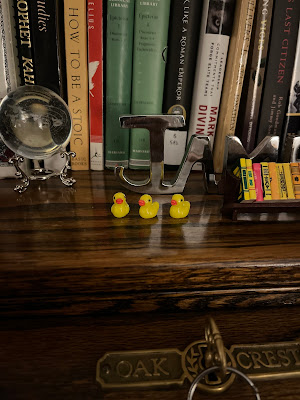
HEAD(hed), (n.) 1. the top part of the human body or the front part of an animal where the eyes, nose, east and mouth are. "Your brain is in your head." DIBS(dibz), (n.) 2. a thick, sweet syrup made in countries of the East, especially the Middle East, from grape juice or dates. [Arabic "debs"]--World Book Dictionary, 1976.
I’ve been busy, and not in the best sense. Work has taken over life to the point my health is not as good as it once was. I work 60+ hours a week, not including commute. I might have 3-4 hours a day to do anything else. The rest is sleeping, or trying to. I’m always looking for something else. I’m tired.
Get link
Facebook
X
Pinterest
Email
Other Apps
Taking Another Look At “The Raven” by Edgar Allan Poe
Get link
Facebook
X
Pinterest
Email
Other Apps
-
March 6, 1831 was the day Edgar Allan Poe was expelled from West Point. The story is that before he left, he managed to secure a financial sum from fellow cadets to underwrite a new publication of poetry that, once published, was not well received. The light, humorous fellow known among his friends was not found in the pages, so they collectively threw the book into the river. “The Raven” was published in 1845 and, despite its popularity, did not help him financially. The short work is better read aloud.
After this last reading of “The Raven,” I remembered a Prog album released in 2013 by Steven Wilson titled, “The Raven That Refused To Sing (And Other Stories).” Or TRTRTS, for short. The concept album seems to capture or suggest tones of Poe’s stories and poems while telling some its own ghost stories: of invisible people (everyday people that go unnoticed); of watching a loved one die and learning to move on; of the destruction of an outwardly “perfect person” with a private, secret vice; of a relationship that fell apart; of a wasted life; of a man who has not yet lived and is ready to die. While the song “The Raven That Refused To Sing” itself does not retell Poe’s poem exactly, the parallels are unmistakable and the imagery of the accompanying video suggests intriguing interpretation toward Poe.
Steven Wilson’s story is about a man looking for healing, even if it comes at the end. And I think this is Poe’s story, too.
“Keep constant guard over your perceptions, for it is no small thing you are protecting, but your respect, trustworthiness and steadiness, peace of mind, freedom from pain and fear, in a word your freedom. For what would you sell these things?” EPICTETUS, DISCOURSES, 4.3.6 b –8
Legend has it that the astronomer Ptolemy (1st century A.D.) suggested that falling stars were caused by the gods moving in the heavens, thus knocking stars out of their places. Somehow people reasoned that that if the gods were moving, they must be getting close to earth so they would lift their "prayers" or "wishes" (literally, "desires") whenever they saw the stars falling in hopes the gods would notice and grant a favorable answer. But how does one wish on falling star? Once you see it, it's gone before the wish or prayer can be made! The answer is simple: meteor shower. That's how to get your wish. Mrs. Ann Hodges had a wish fall right into her lap. Sort of. In 1954 Mrs. Hodges was sleeping on the couch when a 8 1/2 pound meteorite fell through her house and into her living room where it bounced off the radio and struck her left hip leaving her with a bruise. Not sure what she was wishing, but that's not how to do it. Epictetus hel...