HEAD(hed), (n.) 1. the top part of the human body or the front part of an animal where the eyes, nose, east and mouth are. "Your brain is in your head." DIBS(dibz), (n.) 2. a thick, sweet syrup made in countries of the East, especially the Middle East, from grape juice or dates. [Arabic "debs"]--World Book Dictionary, 1976.
Starting chapter 10 exhausted. Need to take a break. The closer to the end I get, the steeper the climb, as it were. Just gets harder near the end. I’m having eye surgery consultation later this week. I’m thinking the eye strain is too much for this little pea brain. Everything jumbles together. But so excited this is happening!
Get link
Facebook
X
Pinterest
Email
Other Apps
The Thing of Beauty
Get link
Facebook
X
Pinterest
Email
Other Apps
-
The approaching Christmas day has me thinking about one nearly overlooked facet of God’s attributes: His Beauty. The dark of night is twinking bright with colored lights of stars above and homes below. Whatever Christmas may be, we all agree this is a time of beauty so as creatures made in God’s image, we creatively add attractiveness to that which would otherwise be dreary with light and color and sounds and smells and warmth and laughter. Consciously or otherwise, this time of year we reflect outward that which draws us to Him: beauty. Attractiveness.
There is another side to beauty but before we quickly say, “oh, that would ‘ugliness,’” let us first discover where beauty resides and then the source of un-beauty (whatever that is).
I turn to an experiment that recently took place on the streets of New York. If I had not seen this with my own eyes, I, too, would think I had made this up. A small group of “someones” rolled an old upright piano out onto a sidewalk then pointed a camera from the window of a nearby building to capture what happened. The camera recorded people walking by the piano, looking at the piano, looking around, touching the piano, playing the piano. Some plinked with fingers, others found entire tunes. Music filled the air, smiles grew on faces and people left the piano changed people. Some people pushed the piano, tried to move the piano. A car pulled up along the curb and the driver tried to push the piano into the backseat.
The beat up piano sat on the sidewalk all day, drawing people near with their bags and carts, cameras and pets, then sending them away with smiles and laughter and wonder. A few brief moments on the keyboard drove away the chilly weather. Car horns and engine noises were dressed with Chop Sticks and perhaps a Sonata.
All day, all night. People coming. People touching. People going.
The next day, something happened. Some men appeared with sledge hammers. They destroyed the piano, right there in broad daylight. Nobody stopped them, not even the photographer. The photographer was not even there. We know this because later, after the piano was reduced to toothpicks and swept away--yes, the men who destroyed the piano actually swept pieces into a pile and put them in a bin while other larger pieces were thrown over a fence--two other men came with a piano dolly to collect. They found an empty sidewalk, empty except for other trash that sat unmolested on the curb from the day before. What happened to the piano? The camera recorded it all, including the discovery of the owner.
Some people are not attracted. They are blind to beauty. Beauty simply is, but some will not recognize it for what it is. This is why, for reasons unknown, a man will turn a gun on school children. This is not beautiful, and when beauty is destroyed, it is nearly indescribable un-beauty.
God, the source of Beauty, laid aside His glory and in being born a man on this earth, still attracted shepherds and so many others who came to him in all their unbeauty and left changed. Scripture says that he was not one of physical attraction, but people were drawn to Him. Then men came along with hammers, to wreck Him and sweep Him aside . . .
One probably wonders what I’m working on. As an Independent Scholar, as I am not attached to a University, I am writing a commentary on the first book of a personal journal written by a 2nd Century Roman Emperor. In that book he lists 16 names and describes what each person contributed to his life. That’s the short version. I’ve covered the first 8 so far and hit a wall. Now I’ve gone back and am editing Chapters 1-3 to keep my mojo going. Not sure when I’ll be done but hopefully by years’ end. I already have another project lined up.
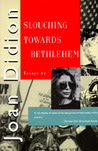
I'm nearly finished reading Joan Didion's collection of essays, Slouching Towards Bethlehem. The book was discovered through another book I was reading, Jon Krakauer's Eiger Dreams . If Jon felt this book was good enough to pack along on a mountain climbing expedition, then I'm interested. Took me three tries, but I finally found my copy on Amazon. One of the best book buys I've made. Joan selected the title of this book from William Butler Yeats' classic poem, Second Coming . The book title is shared with one of her larger essays, a record of encounters with people in the 1960's drug culture. Didion's book is divided into three distinct parts: "Life Styles In The Golden Land," a collection of articles capturing the California experience of the 1960's; "Personals," a few of essays of the first-hand nature; and "Seven Places Of The Mind", some thoughts about those parts of California that are now long gone. One essay...