Writing on “The Education of Children,” Montaigne addresses his essay to Madame Diane De Foix, Comtesse de Gurson, who is expecting her first child. He writes in response to her request for advice. Montaigne’s emphasis has been on the need to educate children in virtue before knowledge, that one must digest what is learned to make it part of oneself, not regurgitate. The goal of education is not “to cover a man’s self (as I have seen some do) with another man’s armour, so as not to discover so much as his fingers’ ends.”
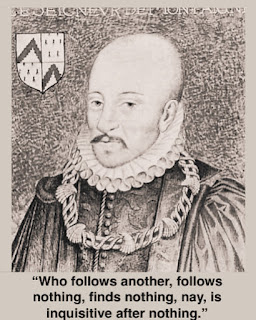
Montaigne admits he has no specific method or philosophy regarding education, but as he writes, a theme or rubric comes clear. Some sciences are specific and easily applied (such as farming), “But, in truth, all I understand as to that particular is only this, that the greatest and most important difficulty of human science is the education of children. . . . it is no hard matter to get children; but after they are born, then begins the trouble, solicitude, and care rightly to train, principle, and bring them up.”
His rubric is simply: character before information. “Let him make him examine and thoroughly sift everything he reads, and lodge nothing in his fancy upon simple authority and upon trust.” Montaigne holds that bookish learning is an ornament when a foundation is required for building.
The best learning is found in travel, encountering first-hand the histories, manners, conversations of The World. Montaigne learned German and Latin at a young age because he once lived among people who did not speak his native French. “I would that a boy should be sent abroad very young, and first . . . into those neighbouring nations whose language is most differing from our own, and to which, if it be not formed betimes, the tongue will grow too stiff to bend. A child should not be brought up in his mother’s lap.” Boys should get dirty, do hard work and grow strong. Let his curiosity be tempered with discretion. Again, the rubric: “Let his conscience and virtue be eminently manifest in his speaking, and have only reason for their guide.” Let him learn from everyone and be deceived by no one.