The Best-Looking Man and The Motorcycle Saint (Day 5)
- Get link
- X
- Other Apps
The patron saint of motorcyclists happens to be Columbanus (ca. 543-615 AD). You know what a “patron saint” is, don’t you? A patron saint is (simply put) the special protector, the heavenly advocate of anything important to us. “Recently, the popes have named patron saints but patrons can be chosen by other individuals or groups as well. Patron saints are often chosen today because an interest, talent, or event in their lives overlaps with the special area.” (The Catholic Encyclopedia). Maybe you’ve heard (or prayed):
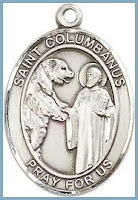
Not sure why or how Columbanus became the Motorcycle saint--was it because he was “all over the map,” travelling through Ireland planting churches, living in caves? Or because he wrestled a bear and walked through a pack of wolves? Or because he multiplied bread and beer like Jesus did with the fish and loaves (after all, he was Irish)? Whatever the reason, here’s a poem penned by the Motorcycle saint:
There’s a beauty that never fades and it’s not found in outward appearances. It’s a kind of beauty that is captivates some and repels others. And it’s found beyond us, beyond you and me.
"You are the most handsome of the sons of men; grace is poured upon your lips; therefore God has blessed you forever." (Psalm 45:2)
The most attractive man of all time gains that title through the eyes of those who love Him, but it’s not a physical beauty that makes him the most fair. “Grace is poured” on His lips and because of this, God has blessed him forever. This makes him top-notch. He speaks with favor, with kindness, is pleasant. This is not speaking with “charm” but speaking with the needs of others in mind, bringing comfort to those who hear. The words of the King do not "drive" his people, but provide what His people need for life--and to enjoy His presence.
He is attractive by how he speaks. He shares with others what he receives from God--this is the meaning of “blessed.” He does not keep what he receives to himself. He desires the good will of his subjects and (in a manner of speaking) “kisses” those around him with a kind and gentle heart. There’s a kind of radiance in that, a kind of radiance that causes others to want to be near him.
No wonder the writer gushes the adoration as he does, expressing the love of the bride with such carefully chosen words.

“Columbanus be my guide,
as I climb upon my ride
Let your halo light the way,
keep me safe from harm today
Find a peaceful sunny place,
and let it shine upon my face
Keep the clouds and rain at bay,
and keep me dry throughout the day
Watch over those who ride with me,
keep them safe and close to thee
Keep my wheels upon the ground,
so I'll return home safe and sound
Should disaster be my fate,
guide me on through heaven's gate
If I must join my fallen brethren
Please show me the way to biker's heaven.”
“The beauty of men
shall vanish in old age.
All former comeliness
is wiped away with grief.
The radiance of Christ’s face,
lovely before all things,
is more to be desired
than the frail flower of flesh.”
There’s a beauty that never fades and it’s not found in outward appearances. It’s a kind of beauty that is captivates some and repels others. And it’s found beyond us, beyond you and me.
"You are the most handsome of the sons of men; grace is poured upon your lips; therefore God has blessed you forever." (Psalm 45:2)
The most attractive man of all time gains that title through the eyes of those who love Him, but it’s not a physical beauty that makes him the most fair. “Grace is poured” on His lips and because of this, God has blessed him forever. This makes him top-notch. He speaks with favor, with kindness, is pleasant. This is not speaking with “charm” but speaking with the needs of others in mind, bringing comfort to those who hear. The words of the King do not "drive" his people, but provide what His people need for life--and to enjoy His presence.
He is attractive by how he speaks. He shares with others what he receives from God--this is the meaning of “blessed.” He does not keep what he receives to himself. He desires the good will of his subjects and (in a manner of speaking) “kisses” those around him with a kind and gentle heart. There’s a kind of radiance in that, a kind of radiance that causes others to want to be near him.
No wonder the writer gushes the adoration as he does, expressing the love of the bride with such carefully chosen words.
- Get link
- X
- Other Apps
Popular posts from this blog
I’ll Be Gnome For Christmas
“And so, about this tomb of mine . . . “
“VANITY, saith the preacher, vanity! Draw round my bed: is Anselm keeping back? Nephews—sons mine … ah God, I know not! Well— She, men would have to be your mother once, Old Gandolf envied me, so fair she was! What’s done is done, and she is dead beside, Dead long ago, and I am Bishop since, And as she died so must we die ourselves, And thence ye may perceive the world’s a dream. Life, how and what is it? As here I lie In this state-chamber, dying by degrees, Hours and long hours in the dead night, I ask “Do I live, am I dead?” Peace, peace seems all. Saint Praxed’s ever was the church for peace; And so, about this tomb of mine. I fought With tooth and nail to save my niche, ye know: —Old Gandolf cozened me, despite my care; Shrewd was that snatch from out the corner South He graced his carrion with, God curse the same! Yet still my niche is not so cramped...
The Island-Fish
“O ye passengers, whom may God preserve! come up quickly in to the ship, hasten to embark, and leave your merchandise, and flee with your lives, and save yourselves from destruction; for this apparent island, upon which ye are, is not really an island, but it is a great fish that hath become stationary in the midst of the sea, and the sand hath accumulated upon it, so that it hath become like an island, and trees have grown upon it since times of old; and when ye lighted the fire upon it, the fish felt the heat, and put itself in motion, and now it will descend with you into the sea, and ye will all be drowned: then seek for yourselves escape before destruction, and leave the merchandise.—The passengers, therefore, hearing the words of the master of the ship, hastened to go up into the vessel, leaving the merchandise, and their other goods, and their copper cooking-pots, and their fire-pots; and some reached the ship, and others reached it not. The island had moved, and descended...