HEAD(hed), (n.) 1. the top part of the human body or the front part of an animal where the eyes, nose, east and mouth are. "Your brain is in your head." DIBS(dibz), (n.) 2. a thick, sweet syrup made in countries of the East, especially the Middle East, from grape juice or dates. [Arabic "debs"]--World Book Dictionary, 1976.
Starting chapter 10 exhausted. Need to take a break. The closer to the end I get, the steeper the climb, as it were. Just gets harder near the end. I’m having eye surgery consultation later this week. I’m thinking the eye strain is too much for this little pea brain. Everything jumbles together. But so excited this is happening!
Get link
Facebook
X
Pinterest
Email
Other Apps
The Tongue Of A Ready Scribe (Day 3)
Get link
Facebook
X
Pinterest
Email
Other Apps
-
"My heart overflows with a pleasing theme; I address my verses to the king; my tongue is like the pen of a ready scribe." (Psalm 45:1)
When you write a letter, how do you begin? “Dear . . .”
Do you write your Mom or Dad (you do write your Mom, or at least call, right?) in the same way you would your boss or a judge or a Congressman--or the President? Seems the higher up the ladder you go, the more language seems to change--or it should. Of course you should always give Mom the highest respect, right? There is respect . . . right?
This musician could have one day said, “Check out this new song I wrote on the way to the palace” (or something like that). But he doesn’t. He puts pen to paper and pours this love song onto vellum or parchment, etching the song into a permanent form. So permanent, it’s been on record (pun intended) for thousands of years. Remember how the song is also addressed to lead singers everywhere--so this song can be played by anyone who knows the lyrics. Over the course of time, it’s been translated into every known language of the world! So it can be sung, or at least read in any culture. Genius, I tell you.
But this says something about the King, doesn’t it? Who is this King? If you were the writer, what would you say? Our writer here is a “ready scribe.” He’s given thought to the “good words”, his “pleasant theme” because his song is for the King! He’s thought over the words of this love song, for they must be just right. A well-written song grabs you, works it’s way in and won’t let go. This is where we begin to make our way to the wisdom hidden of this song.
The weight of the simile (“my tongue is like the pen of a ready scribe”) shows how the “good words” of the song are not lost to the air but are carefully chosen and given longevity. You’ve heard a “slip of the tongue” but there is no “slip of the pen” here. There is discipline, diligence on the part of the writer. He writes with skill.
But why? Why does he write thusly? The reasons are simple: first, he recognizes the King is above him. Writing carelessly insists that the one with most authority bow down to him and this cannot be. The King deserves the best. Second, he loves his King and he loves the one who the King loves, that is, His Bride. Careless and sloppy writing does not show love nor help express it. Besides, insulting the King is one thing--speak lightly of His bride--that’s worse.
One probably wonders what I’m working on. As an Independent Scholar, as I am not attached to a University, I am writing a commentary on the first book of a personal journal written by a 2nd Century Roman Emperor. In that book he lists 16 names and describes what each person contributed to his life. That’s the short version. I’ve covered the first 8 so far and hit a wall. Now I’ve gone back and am editing Chapters 1-3 to keep my mojo going. Not sure when I’ll be done but hopefully by years’ end. I already have another project lined up.
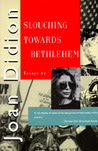
I'm nearly finished reading Joan Didion's collection of essays, Slouching Towards Bethlehem. The book was discovered through another book I was reading, Jon Krakauer's Eiger Dreams . If Jon felt this book was good enough to pack along on a mountain climbing expedition, then I'm interested. Took me three tries, but I finally found my copy on Amazon. One of the best book buys I've made. Joan selected the title of this book from William Butler Yeats' classic poem, Second Coming . The book title is shared with one of her larger essays, a record of encounters with people in the 1960's drug culture. Didion's book is divided into three distinct parts: "Life Styles In The Golden Land," a collection of articles capturing the California experience of the 1960's; "Personals," a few of essays of the first-hand nature; and "Seven Places Of The Mind", some thoughts about those parts of California that are now long gone. One essay...