HEAD(hed), (n.) 1. the top part of the human body or the front part of an animal where the eyes, nose, east and mouth are. "Your brain is in your head." DIBS(dibz), (n.) 2. a thick, sweet syrup made in countries of the East, especially the Middle East, from grape juice or dates. [Arabic "debs"]--World Book Dictionary, 1976.
I’ve been spending the last few months on something I’ve always wanted to do: write a book. I’m using every possible moment on this project and it’s really coming along. I am currently 7 chapters completed out of a potential 20. However, given the source material, each chapter is just a little bit longer than the previous. So who knows when I’ll be finished. I’m learning so much tho!
Get link
Facebook
X
Pinterest
Email
Other Apps
What Is A "Dark Night Of The Soul"? Suffering In Love
Get link
Facebook
X
Pinterest
Email
Other Apps
-
"One dark night,
fired with love's urgent longings
-- ah, the sheer grace! --
I went out unseen,
my house being now all stilled."
(St. John of the Cross, the mid-1500's)
One aspect of the "the dark night of the soul" can be described as that time in a person's life when God wants to draw him/her closer to Himself and that person has either no desire for God and resists His wooing or that person hears God's call and follows.
When The Lover calls, the Beloved at first is overwhelmed with unconditional love and may resist, but when at last giving in to the call, the Beloved realizes one has a decision to make, another "dark night," as it were. One must either leave the current state (mind, heart) and steal away "fired with love's urgent longings" or remain in the dark night of separation from God.
The night is also dark because the soul is being led by God into a "night" of uncertainty, of taking The Beloved away from everything he or she once knew . . . a night of pain, of second-guessing, or tears, of dying. Again, a "night" of decision. The Beloved overshadows with grace if only the Beloved would accept it . . .
. . . and in John's poem, grace is accepted and The Beloved goes to meet The Lover on a dark night, fired by love, sneaking out of the house . . .
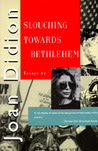
I'm nearly finished reading Joan Didion's collection of essays, Slouching Towards Bethlehem. The book was discovered through another book I was reading, Jon Krakauer's Eiger Dreams . If Jon felt this book was good enough to pack along on a mountain climbing expedition, then I'm interested. Took me three tries, but I finally found my copy on Amazon. One of the best book buys I've made. Joan selected the title of this book from William Butler Yeats' classic poem, Second Coming . The book title is shared with one of her larger essays, a record of encounters with people in the 1960's drug culture. Didion's book is divided into three distinct parts: "Life Styles In The Golden Land," a collection of articles capturing the California experience of the 1960's; "Personals," a few of essays of the first-hand nature; and "Seven Places Of The Mind", some thoughts about those parts of California that are now long gone. One essay...
“VANITY, saith the preacher, vanity! Draw round my bed: is Anselm keeping back? Nephews—sons mine … ah God, I know not! Well— She, men would have to be your mother once, Old Gandolf envied me, so fair she was! What’s done is done, and she is dead beside, Dead long ago, and I am Bishop since, And as she died so must we die ourselves, And thence ye may perceive the world’s a dream. Life, how and what is it? As here I lie In this state-chamber, dying by degrees, Hours and long hours in the dead night, I ask “Do I live, am I dead?” Peace, peace seems all. Saint Praxed’s ever was the church for peace; And so, about this tomb of mine. I fought With tooth and nail to save my niche, ye know: —Old Gandolf cozened me, despite my care; Shrewd was that snatch from out the corner South He graced his carrion with, God curse the same! Yet still my niche is not so cramped...