HEAD(hed), (n.) 1. the top part of the human body or the front part of an animal where the eyes, nose, east and mouth are. "Your brain is in your head." DIBS(dibz), (n.) 2. a thick, sweet syrup made in countries of the East, especially the Middle East, from grape juice or dates. [Arabic "debs"]--World Book Dictionary, 1976.
Finishing Chapter 8. Halfway through but it’s an uphill climb. Need a break but afraid of stopping.
Get link
Facebook
X
Pinterest
Email
Other Apps
Day 2: What Does It Take To Be A Man?
Get link
Facebook
X
Pinterest
Email
Other Apps
-
Many books fill my shelves and if I can't find what I'm looking for, I know where to find more books. Entire rooms and buildings full of individuals speaking their mind on pages. A silent crowd all speaking at once on their subjects.
No matter where I look, I am unable to find a book or passage that adequately says "this is a man." Is the man a kind of warlord and conqueror? A wild man? Does he suddenly appear on the scene or does he arrive subtly? Does he "bang on his shield," declaring his existence and receive his entitlement or does he quietly and unassumingly work for all he wants or needs? Benjamin Franklin's quest led him to find virtue by imitating Socrates and Jesus--is a man's life defined by what he dies for? It's an age-old question that even Tom Scholz of one of my favorite bands, "Boston" sought to find out (lyrics here):
There must be something more to manhood than being the adult human male. This is why I like Tom's song.
A man must have heart and soul, strength and gentleness, the ability to look ahead and outside himself.
A man must be willing to give and even if there's nothing to receive.
A man knows what he believes, knows why he believes it and speaks with conviction with what he knows.
A man is aware of what he feels as well as what others feel. He empathizes and sympathizes.
A man is more than a biological construct. He is a thinking, feeling soul.
In short, a man is forward-moving, seeking to better himself and contribute to those around him.
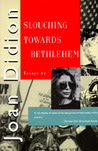
I'm nearly finished reading Joan Didion's collection of essays, Slouching Towards Bethlehem. The book was discovered through another book I was reading, Jon Krakauer's Eiger Dreams . If Jon felt this book was good enough to pack along on a mountain climbing expedition, then I'm interested. Took me three tries, but I finally found my copy on Amazon. One of the best book buys I've made. Joan selected the title of this book from William Butler Yeats' classic poem, Second Coming . The book title is shared with one of her larger essays, a record of encounters with people in the 1960's drug culture. Didion's book is divided into three distinct parts: "Life Styles In The Golden Land," a collection of articles capturing the California experience of the 1960's; "Personals," a few of essays of the first-hand nature; and "Seven Places Of The Mind", some thoughts about those parts of California that are now long gone. One essay...
“VANITY, saith the preacher, vanity! Draw round my bed: is Anselm keeping back? Nephews—sons mine … ah God, I know not! Well— She, men would have to be your mother once, Old Gandolf envied me, so fair she was! What’s done is done, and she is dead beside, Dead long ago, and I am Bishop since, And as she died so must we die ourselves, And thence ye may perceive the world’s a dream. Life, how and what is it? As here I lie In this state-chamber, dying by degrees, Hours and long hours in the dead night, I ask “Do I live, am I dead?” Peace, peace seems all. Saint Praxed’s ever was the church for peace; And so, about this tomb of mine. I fought With tooth and nail to save my niche, ye know: —Old Gandolf cozened me, despite my care; Shrewd was that snatch from out the corner South He graced his carrion with, God curse the same! Yet still my niche is not so cramped...