HEAD(hed), (n.) 1. the top part of the human body or the front part of an animal where the eyes, nose, east and mouth are. "Your brain is in your head." DIBS(dibz), (n.) 2. a thick, sweet syrup made in countries of the East, especially the Middle East, from grape juice or dates. [Arabic "debs"]--World Book Dictionary, 1976.
Starting chapter 10 exhausted. Need to take a break. The closer to the end I get, the steeper the climb, as it were. Just gets harder near the end. I’m having eye surgery consultation later this week. I’m thinking the eye strain is too much for this little pea brain. Everything jumbles together. But so excited this is happening!
Get link
Facebook
X
Pinterest
Email
Other Apps
Balance Of The Arts
Get link
Facebook
X
Pinterest
Email
Other Apps
-
January 20, 1961, John F. Kennedy was inaugurated the 35th President of the United States. At the inauguration, poet Robert Frost read his poem, "The Gift Outright"
The land was ours before we were the land’s. She was our land more than a hundred years Before we were her people. She was ours In Massachusetts, in Virginia, But we were England’s, still colonials, Possessing what we still were unpossessed by, Possessed by what we now no more possessed. Something we were withholding made us weak Until we found out that it was ourselves We were withholding from our land of living, And forthwith found salvation in surrender. Such as we were we gave ourselves outright (The deed of gift was many deeds of war) To the land vaguely realizing westward, But still unstoried, artless, unenhanced, Such as she was, such as she would become.
January 29, 1963, Robert Frost died. The impact "The Gift Outright" made on JFK was so significant that on October 26, 1963, Kennedy delivered a speech at Amherst College at an event held in honor of Frost. While on the surface one may hear Kennedy underscore the role of the arts in regards to a nation. But don't miss the fact that here is a world leader embodying the very subject on which he spoke. The poet-statesmen are gone.
Gone are the days when our leaders prove they understand the human spirit by how they embody, even enjoy the arts. The arts provide balance to the business of man whether his business be as grand as government or as small as the rule of the home. Kennedy explains how.
Here are Kennedy's remarks again, describing the role of poetry and the arts in government, or all that man puts his hand to do, for that matter:
"Robert Frost coupled poetry and power, for he saw poetry as the means of saving power from itself. When power leads men towards arrogance, poetry reminds him of his limitations. When power narrows the areas of man’s concern, poetry reminds him of the richness and diversity of his existence. When power corrupts, poetry cleanses. For art establishes the basic human truth which must serve as the touchstone of our judgment . . . And the nation which disdains the mission of art invites the fate of Robert Frost’s hired man, the fate of having 'nothing to look backward to with pride, and nothing to look forward to with hope.'”
All this sounds very familiar when considers the role of the philosopher regarding society.
(ht: Open Culture)
One probably wonders what I’m working on. As an Independent Scholar, as I am not attached to a University, I am writing a commentary on the first book of a personal journal written by a 2nd Century Roman Emperor. In that book he lists 16 names and describes what each person contributed to his life. That’s the short version. I’ve covered the first 8 so far and hit a wall. Now I’ve gone back and am editing Chapters 1-3 to keep my mojo going. Not sure when I’ll be done but hopefully by years’ end. I already have another project lined up.
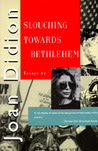
I'm nearly finished reading Joan Didion's collection of essays, Slouching Towards Bethlehem. The book was discovered through another book I was reading, Jon Krakauer's Eiger Dreams . If Jon felt this book was good enough to pack along on a mountain climbing expedition, then I'm interested. Took me three tries, but I finally found my copy on Amazon. One of the best book buys I've made. Joan selected the title of this book from William Butler Yeats' classic poem, Second Coming . The book title is shared with one of her larger essays, a record of encounters with people in the 1960's drug culture. Didion's book is divided into three distinct parts: "Life Styles In The Golden Land," a collection of articles capturing the California experience of the 1960's; "Personals," a few of essays of the first-hand nature; and "Seven Places Of The Mind", some thoughts about those parts of California that are now long gone. One essay...