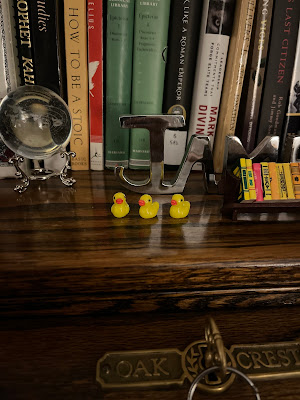
HEAD(hed), (n.) 1. the top part of the human body or the front part of an animal where the eyes, nose, east and mouth are. "Your brain is in your head." DIBS(dibz), (n.) 2. a thick, sweet syrup made in countries of the East, especially the Middle East, from grape juice or dates. [Arabic "debs"]--World Book Dictionary, 1976.
“SHE WAS one of those pretty, charming young ladies, born, as if through an error of destiny, into a family of clerks. She had no dowry, no hopes, no means of becoming known, appreciated, loved, and married by a man either rich or distinguished; and she allowed herself to marry a petty clerk in the office of the Board of Education. . . . She had neither frocks nor jewels, nothing. And she loved only those things. She felt that she was made for them. She had such a desire to please, to be sought after, to be clever, and courted.” —THE NECKLACE Guy de Maupassant France, 1884 (pic by Grok) Read this short story here: https://americanliterature.com/author/guy-de-maupassant/short-story/the-necklace
Get link
Facebook
X
Pinterest
Email
Other Apps
True Happiness (part 2): "What Is Happiness, Anyway?"
Get link
Facebook
X
Pinterest
Email
Other Apps
-
We talk and hear much about happiness today but what is happiness that so many are eager to pursue it? What is unhappiness? How does one know if he or she is unhappy if one does not know what happiness is? What words or terms come to mind when thinking of happiness? Delight. Joy. Freedom from care, pain, sorrow, want. Contentment. I don’t like how the dictionary defines happiness: “the state of being happy.” That doesn’t tell me what happiness is.
Is happiness a destination or a by-product?
Is happiness a choice?
Is happiness good health?
Is happiness a person? or people?
Is happiness a warm donut? A warm puppy? A Warm Gun?
[Original song from The Beatles' White Album]
In Book 3, Prose 2 of Boethius’ “Consolation of Philosophy,” The Love of Wisdom (“philosophy”, personified as a lady in white) defines happiness as “a state which is made perfect by the union of all good things.” A much better definition. In other words, happiness is attaining the highest good. Written in the 400’s AD, Boethius reveals the question of happiness is an ancient one. Mankind across time in every culture has been pursuing happiness, each one on his or her own path to find it.
If The Love of Wisdom ("philosophy") is correct, then it would be right to say that mankind has a built-in desire acquire happiness, apprehend of that which is truly good. The problem is that man gets lost when he considers the many possible paths. Which should he choose?
Does money bring happiness?
Or admiration or perhaps places honor?
Maybe happiness is found in power.
Or in fame, glory.
Or in pleasure.
Whatever happiness is, mankind has been looking for ages and each man or woman has his or her own desire, their own reason for wanting it. Whatever happiness is, that pull that makes us hunt it down is powerful. It is a force of nature. We may disagree on what happiness is and we may disagree on how happiness may be secured, but we all agree that happiness must be so incredibly good, some kind of "highest good," that every person should have it.
“Keep constant guard over your perceptions, for it is no small thing you are protecting, but your respect, trustworthiness and steadiness, peace of mind, freedom from pain and fear, in a word your freedom. For what would you sell these things?” EPICTETUS, DISCOURSES, 4.3.6 b –8
Legend has it that the astronomer Ptolemy (1st century A.D.) suggested that falling stars were caused by the gods moving in the heavens, thus knocking stars out of their places. Somehow people reasoned that that if the gods were moving, they must be getting close to earth so they would lift their "prayers" or "wishes" (literally, "desires") whenever they saw the stars falling in hopes the gods would notice and grant a favorable answer. But how does one wish on falling star? Once you see it, it's gone before the wish or prayer can be made! The answer is simple: meteor shower. That's how to get your wish. Mrs. Ann Hodges had a wish fall right into her lap. Sort of. In 1954 Mrs. Hodges was sleeping on the couch when a 8 1/2 pound meteorite fell through her house and into her living room where it bounced off the radio and struck her left hip leaving her with a bruise. Not sure what she was wishing, but that's not how to do it. Epictetus hel...