An Egyptian "Easter"
- Get link
- X
- Other Apps
Exodus 11-13 are crucial chapters. Thanks to Hollywood, we have had our thinking shaped about the Exodus event. If one takes a fleeting, coursory reading of the text, one misses something, well, quite wonderful.
I've alluded already to the fact that God was working in the lives of two peoples: freeing the Israelites from slavery to bring them to the land He had promised through which the serpent-crushing woman-seed, the blessing of the nations would come. That is the key: blessing of the nations. God was also at work in the lives of the Egyptians that they would know that He is the LORD--and by our last entry, we saw that some were actually getting the idea! The main feature we not miss is that in freeing one, God also works toward another and He did so in ways that both parties could understand.
Now we approach the crucial Passover passage, where all the first-born in the land of Egypt would die (11:5ff). The Israelites were instructed specifically to take a lamb, make it a family member and kill and eat it the night of Passover. Check out A.B. Simpson's comments on 12:4 here. Good stuff!
Note 12:12: God will move through the land and will execute judgment against the gods of Egypt! He will uproot all the false theology of the people, and the Israelites better make certain they get in their hearts who God really is. This is why He has taken special pains to not simply deliver plagues, but that the plagues would help the people understand and know exactly who the LORD is!
God told the Israelites specifically to take blood and put it on the doorposts and the lintel. In this way the destroyer would not enter the house. Now, this was a statement that any Egyptian would understand. See, the Egyptians had a practice of decorating the doors of their tombs with writing-specifically on the doorposts and lintels. In some cases those posts and lintels were painted red.
Doorways to Egyptian tombs. 
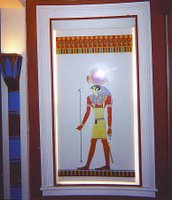
God told Israel to make their homes a tomb because that night, the destroyer would come and kill the firstborn of those whose homes were NOT correctly marked. I think the Sunday School material has it wrong--a little dab of blood here, a smudge of blood there. No, I think that if I knew the destoyer of the LORD was coming, I would do some serious painting so there was no mistake!
Can you imagine what Egypt must have been thinking, watching their servants enter their "tombs" that night? And what about the next morning, after the LORD came through the land, dead lying around everywhere . . . and all of a sudden, the Israelite people come out of their "tombs" . . .
There are many good things here:
I've alluded already to the fact that God was working in the lives of two peoples: freeing the Israelites from slavery to bring them to the land He had promised through which the serpent-crushing woman-seed, the blessing of the nations would come. That is the key: blessing of the nations. God was also at work in the lives of the Egyptians that they would know that He is the LORD--and by our last entry, we saw that some were actually getting the idea! The main feature we not miss is that in freeing one, God also works toward another and He did so in ways that both parties could understand.
Now we approach the crucial Passover passage, where all the first-born in the land of Egypt would die (11:5ff). The Israelites were instructed specifically to take a lamb, make it a family member and kill and eat it the night of Passover. Check out A.B. Simpson's comments on 12:4 here. Good stuff!
Note 12:12: God will move through the land and will execute judgment against the gods of Egypt! He will uproot all the false theology of the people, and the Israelites better make certain they get in their hearts who God really is. This is why He has taken special pains to not simply deliver plagues, but that the plagues would help the people understand and know exactly who the LORD is!
God told the Israelites specifically to take blood and put it on the doorposts and the lintel. In this way the destroyer would not enter the house. Now, this was a statement that any Egyptian would understand. See, the Egyptians had a practice of decorating the doors of their tombs with writing-specifically on the doorposts and lintels. In some cases those posts and lintels were painted red.
Doorways to Egyptian tombs. 
God told Israel to make their homes a tomb because that night, the destroyer would come and kill the firstborn of those whose homes were NOT correctly marked. I think the Sunday School material has it wrong--a little dab of blood here, a smudge of blood there. No, I think that if I knew the destoyer of the LORD was coming, I would do some serious painting so there was no mistake!
Can you imagine what Egypt must have been thinking, watching their servants enter their "tombs" that night? And what about the next morning, after the LORD came through the land, dead lying around everywhere . . . and all of a sudden, the Israelite people come out of their "tombs" . . .
There are many good things here:
- We plainly see Jesus here in the lamb being raised as one of the family and killed;
- We obviously see the concept of the resurrection is not new;
- We see God in two roles that night: one who moves through the land as Destroyer; and one who covers the door and prevent the Destroyer from coming in--God dwelt with His people that night! He covered the door as one who hovers--He did not merely "skip over" or "pass over" the houses marked. He "covered over"!
Then the Egyptians begged them to leave.
And the Egyptians were plundered.
And some of those who oppressed Israel actually went with them in deliverance! (Ex. 12:42ff)
- Get link
- X
- Other Apps
Popular posts from this blog
“And so, about this tomb of mine . . . “
“VANITY, saith the preacher, vanity! Draw round my bed: is Anselm keeping back? Nephews—sons mine … ah God, I know not! Well— She, men would have to be your mother once, Old Gandolf envied me, so fair she was! What’s done is done, and she is dead beside, Dead long ago, and I am Bishop since, And as she died so must we die ourselves, And thence ye may perceive the world’s a dream. Life, how and what is it? As here I lie In this state-chamber, dying by degrees, Hours and long hours in the dead night, I ask “Do I live, am I dead?” Peace, peace seems all. Saint Praxed’s ever was the church for peace; And so, about this tomb of mine. I fought With tooth and nail to save my niche, ye know: —Old Gandolf cozened me, despite my care; Shrewd was that snatch from out the corner South He graced his carrion with, God curse the same! Yet still my niche is not so cramped...
I’ll Be Gnome For Christmas
"On Keeping A Notebook" by Joan Didion
I'm nearly finished reading Joan Didion's collection of essays, Slouching Towards Bethlehem. The book was discovered through another book I was reading, Jon Krakauer's Eiger Dreams . If Jon felt this book was good enough to pack along on a mountain climbing expedition, then I'm interested. Took me three tries, but I finally found my copy on Amazon. One of the best book buys I've made. Joan selected the title of this book from William Butler Yeats' classic poem, Second Coming . The book title is shared with one of her larger essays, a record of encounters with people in the 1960's drug culture. Didion's book is divided into three distinct parts: "Life Styles In The Golden Land," a collection of articles capturing the California experience of the 1960's; "Personals," a few of essays of the first-hand nature; and "Seven Places Of The Mind", some thoughts about those parts of California that are now long gone. One essay...